
Superconductivity Research Library

Literature, material data, and reference articles for superconductivity research.

Browse materials
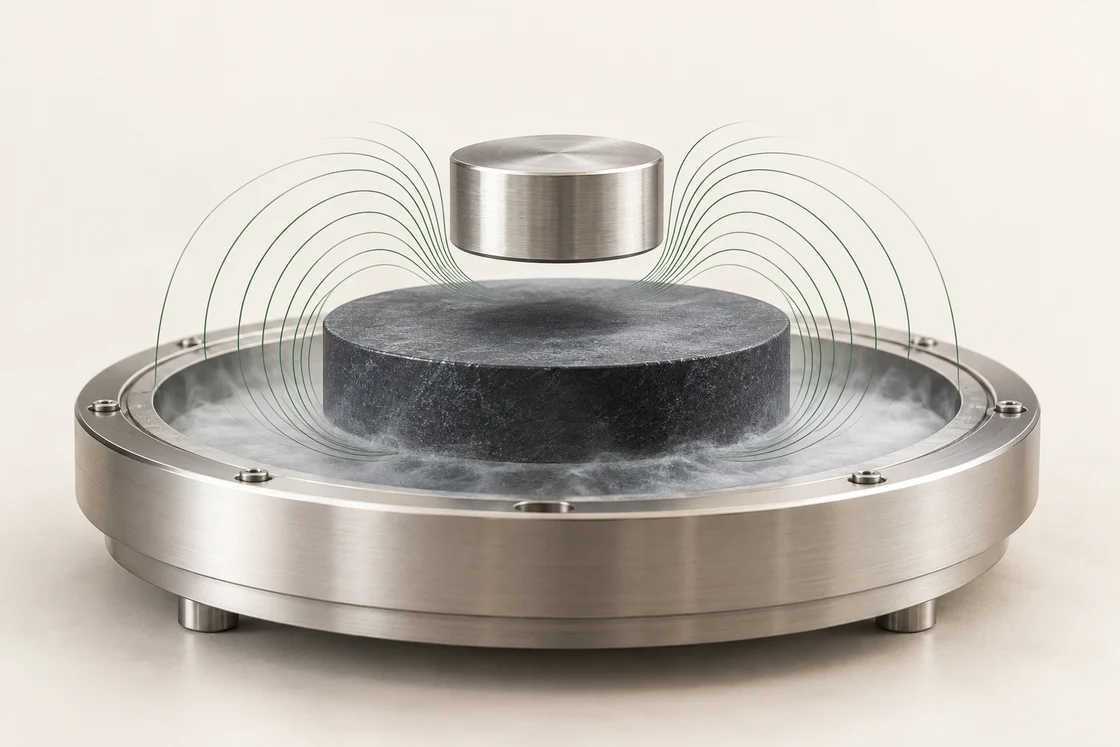
Conceptual illustration of a magnet levitating above a cooled superconducting material; not an experimental photograph.

Selected from the literature

Latest research

All editions

2026-W42 · Selected 18 Oct 2026 · Sources checked 18 Oct 2026

Published

Nature Communications

Probing broken time-reversal symmetry in graphene

Josephson interferometry in magic-angle twisted trilayer graphene reveals asymmetric interference and field-sweep hysteresis below about 0.8 K, beneath the superconducting onset near 2 K.

Peer-reviewed · early version

Read original paper ↗
Why it matters & evidence limits

Why it matters. Phase-sensitive probes help connect interference measurements to candidate superconducting symmetries.

Evidence limits. The authors interpret these signatures as consistent with broken time-reversal symmetry; they do not uniquely establish a chiral pairing state.

Publisher abstract and publication-status notice; no full-text or independent replication review.

Phase-sensitive signatures of time-reversal-symmetry-breaking superconductivity in magic-angle twisted trilayer graphene

Checked 18 Oct 2026. Publisher record as checked on 2026-10-18

DOI: 10.1038/s41467-026-78374-3

First selected in 2026-W42.

Explore: Two-dimensional superconductivity →
Published

Nature Materials

Interlayer coherence in superconducting nickelates

X-ray spectroscopy of protected (La,Pr)3Ni2O7 films links superconductivity to coherent interlayer orbital hybridization, with oxygen content and epitaxial strain tuning the electronic states.

Peer-reviewed article

Read original paper ↗
Why it matters & evidence limits

Why it matters. A material-specific link between orbital coherence and superconductivity guides comparisons between nickelate samples.

Evidence limits. This film-specific evidence supports a multiorbital interpretation but does not by itself settle the pairing mechanism across nickelate families.

Publisher abstract and bibliographic record; subscription full text and raw data not reviewed.

Interlayer hybridization promotes superconductivity in bilayer nickelates

Checked 18 Oct 2026. Publisher record as checked on 2026-10-18

DOI: 10.1038/s41563-026-02750-z

First selected in 2026-W42.

Explore: Nickelate superconductors →
Published

Nature

Superconductivity in a single copper–oxygen plane

Monolayer Bi-2201 retains superconductivity with one CuO2 plane, while controlled oxygenation reveals an intermediate anomalous metal and unusual scaling near the superconductor–insulator transition.

Peer-reviewed article

Read original paper ↗
Why it matters & evidence limits

Why it matters. A single-plane platform helps isolate how dimensionality and oxygen tuning affect cuprate transport.

Evidence limits. The reported phase behavior concerns this material and tuning protocol; its zero-temperature interpretation is inferred from finite-temperature measurements.

Publisher abstract and bibliographic record; subscription full text and raw data not reviewed.

Superconducting 2D cuprate with a single CuO2 plane

Checked 18 Oct 2026. Publisher record as checked on 2026-10-18

DOI: 10.1038/s41586-026-10857-1

First selected in 2026-W42.

Explore: Cuprate superconductors →

Editorial selections with original sources and stated review limits.

Library coverage

Indexed papers
75,202
Catalogued materials
19,042
Latest indexed paper
3 Sept 2026

Catalogued materials include records outside the current public browsing scope. Statistics refreshed 20 Nov 2026 (UTC).

View coverage and update details

Explore the research

TcTimeline

Explore reported superconducting transition temperatures through time.

Open TcTimeline

Loading reported Tc data…

Follow the evidence to its source

Material properties depend on reported conditions. Check pressure, temperature, experimental or computational origin, and the source literature before comparing results.

Read about data and methodology

Read research leads in context

AI-assisted extraction may contain errors. Research priorities and candidate leads are not superconductivity probabilities or confirmed discoveries.

Developed by JZIS

JZ Institute of Science maintains SCLib to support superconductivity research through accessible literature, source-linked data and transparent methods.

About JZ Institute of Science
SCLib by JZIS | Superconductivity Research Library